Saturday, 22 June 2013

A quiet leader - Nokuphumla Pakamile

It is a bright, sunny Thursday afternoon and we’re meeting up with Nokuphumla ‘Ma Phumla’ Pakamile, mother, wife, guardian, teacher, student, gardener, singer, and dancer.  It is after school, and Phumla is down in her garden behind the classroom block picking iMifino, an indigenous and edible ‘weed’, which she will add to the supper she prepares at home tonight.  She is accompanied by Gloria Kumalo, a fellow teacher, and they are talking about how the children have been progressing with their navigational skills on the brand new computers that have just been donated to their school.  They laugh as they refer to how both their students and their own children are growing up as ‘Digital Natives’ in a world of technology, with its sleek hyper-speed cell-phone and internet communications, and how very differently their own and older generations of ‘Digital Immigrants’ are experiencing the world.

For those of you who have met and worked with Phumla, you need no introduction.  We are talking to Ma Phumla today because we think that personalities such as hers deserve more attention.  We are talking about people who are sensitive to the needs of others, who have just a human-full of compassion but are able to stretch it as far as they need to because they have found within themselves the will and the self-love to empower this natural urge, and that this is what truly makes a difference in our world.
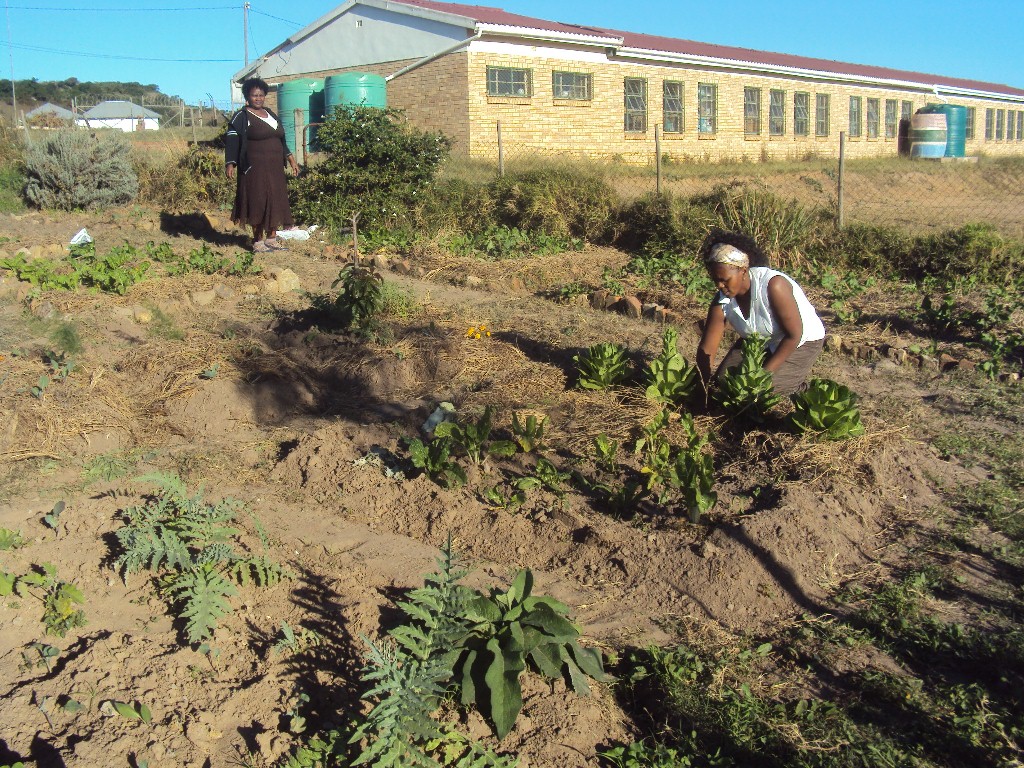

Phumla adding mulch to the plants in her garden, with Gloria behind her, and the buildings of Chintsa East Primary School in the background

Phumla started working at Chintsa East Primary School in 1998 (the original school was established in1972, and the new and existing building went up in 1996).  Before that she was teaching at an informal school that was housed in a shack.  It was during this time, round about 2010, that she made the decision to start doing short Early Childhood Development (ECD) courses.  In the same year she started studying her National Professional Diploma in Education (NPDE), which she manages to work on each Saturday through the University of Fort Hare, East London campus.  She will complete the diploma this year.  While she studies she is teaching at Chintsa East Primary as a Grade R Practitioner.  On completion of her studies she wants to become a full-time teacher.

She started learning about Permaculture in 2003, joining up her school garden with others in the surrounding area to form a cluster of functional, learning environments in which to further the aims of permacultural principles.  She shows us the soil in her garden, saying “This beautiful earth was once a mixture of clay mixed with weak sand.  It was very unforgiving.  We have worked hard in the garden to rehabilitate the soil.”  In 2008 she did a one-year sustainable living course in East London, graduating at Rhodes university, and gives full credit to Laura Conde (of WESSA) for introducing her to the course: “She put me closer to nature!”  She is an ambassador for eco-schools (http://wessa.org.za/what-we-do/eco-schools.htm ) and keeps the garden we are standing in, as well as a garden just a hundred meters away, known as the ‘Biogas’ garden, because it is fed by water that runs out of the BIOGAS system located on the west side of the grounds, off the school’s toilet block (this system is also designed to feed the school’s kitchens, where the ovens are fired up by the methane gas by-product).

But all of this is only the ‘professional’ side of Phumla.  She has been married for 20 years and has 5 children, and this is the beginning of her colourful life story.  Her mornings are taken up by her teaching, but her afternoons are filled, not only with her studies, but with looking after her own children, as well as the children who can not go home directly after school because there is no one at home for them to be or play with: Phumla has also opened up her home to a number of children both from within her own extended family and without, who have either a very disruptive or dysfunctional home situation, or who, due to some other unforeseen circumstances, simply have no home at all.  So she has quite a large home now, and her charge is to cook for all these mouths as well as to see to all their individual needs, as a mother can only do.  Her home has now come to be known as a ‘safe house’ for these children, but Phumla says, “I love them and they love me but it is not easy as we live right next door to a shebeen.  It is very noisy, very destructive.” 


In the Biogas garden, Phumla and Gloria work as they talk to Kate & Shaun


And her children are doing well!  Her youngest, Awonke (9), is in Grade 3 at the new African Angels Independent School, a bright spark of a boy who loves reading and is already full of self-confidence and an eagerness to engage with others and with his world; Neziswa (14), is in Grade 9 at Bylett’s School, is a flyhalf on the local girls’ rugby team, and until last year she was the only girl on the Unstressed Surf School program; then there is Sandile (16), who also plays rugby at school, and soccer with the local team too.  He is also a promising surfer and a student with the Unstressed Surf School, and he has recently started doing weightlifting too; and lastly there is Tina (19), an I.T. student at CTI.  Tina is the adventurous one: she’s the #10 on the girls’ rugby team (the same team as her sister) and has won numerous awards for eco-challenges.  She is also very musical, like her mother, and she wants to get into sports science or sports management.  Phumla’s eldest son, Sthembiso (29) lives around the bay and works in Chintsa Bay Restaurant.

So Phumla has her hands full, what with teaching and being a mother to all these outgoing young people!  She tells us, “If I get some time to myself I like to read a biography, or some Xhosa stories, and I also keep some Mills & Boon books around for an easy read.”  But the rest of the time she is directly involved in her community, serving as both a councilling ear to the many issues and grievances of her village as well as on the committee of Friends of Chintsa.   She runs the weekly Garden Club held at the school’s ‘Biogas garden’, helps to manage the Surf School on weekends, and she is also partly involved in the girls’s rugby team.  She also does Zumba once a week.  How does she do it all?

She says it all has to do with responsibility, and also that the children love her so much.  When we asked her what her biggest challenges are, and what her vision is for herself, her family, her school and her community, she replied “One of the issues that concerns me is the lack of appreciation from some of the members of the community for property and projects that find their way into their village.  That, and a lack of funds.”  She wants to see her village become a place for responsible citizens, and her school growing with more effective leadership, teachers, and learners.  “I can definitely do with more teachers, and more buildings to expand the school,” she says.


WHERE AM I FROM? A poem by Phumla 
  
I am from Nonqaba Tubby Pati, a Xhosa girl from  Macleantown village
I from waking up early, go to the veld fetch iNzinziniba herb to make tea
for my brothers and sisters,
I am from milking the goats and making tea in the morning
I from making tea for my aunties and uncles before going to school in the
morning.

I am from dolls made from mealie-cob and old materials,
I am from the doll’s house made of mud and stones,
I am from a village, houses made of mud, wood and thatched roofs,
I am from a village without electricity, but the moon and the stars are lights.
I am from mealie-fields, planting, weeding with a hoe and harvest.

I am from a traditional family wearing traditional clothes I am from a traditional family wearing traditional clothes,
I am from tradition, women wear long traditional dresses, smear
their bodies with yellow or red clay,
I am from going and collecting cows and goats from the veld every evening
I am feeding the chickens, pigs and dogs every day.

I am from eating cooked mealies, samp and beans, African salad, and amarhewu
I am from eating traditional imifino picked from the garden
I am from always welcoming the traveler and giving him something to eat and water

I am from listening to the elders when talking to me,
I am from respecting people older than me and not call them
by their names rather call them ‘bhuti, sisi, mama , or tata’,
I am from the family values where you greet everyone you
meet on the road even if you don’t know who she/he is.

I am from respecting God, not calling him by his name but rather calling him Jehova
I am from collecting firewood and water from the dam
I am from ‘you are not allowed to choose your own husband—your elders will choose for you.’
I am from breaking that law and choosing my own husband.
I am from growing up without my dad and not even knowing him.
I am from growing up without staying with my mom but with my aunties and uncles.
I am from going to school in a far away village, barefoot sometimes

I am from a family believing in ancestral spirits, from dancing and singing for these spirits
I am from the slaughtering of the goats, sheep and cows in respect for the dead.
I am from Xhosa beer, called umqombothi, drank only on special occasions.
I am part of my family and ancestors and they are also part of me.

I am Nokuphumla Pakamile         
___________

Her message to all of you: “Stand up for your community.  Never give up.  Keep up the good work!”  And to children she has this to say: “Focus on your studies at school today so that you can be a responsible citizen tomorrow!”  How often do we meet people, indeed women, of this calibre?  Ma Phumla, we salute you!


For more on Phumla's incredible life journey please read this blog

Saturday, 8 June 2013

Social responsibility and the importance of NPOs

Part 2 – The role and importance of NPOs

This week I attended my very first ‘village council’ meeting.  I joined out of curiosity: what really goes on, what is really discussed, and what is accomplished by these individuals among us who volunteer their time to community issues?  What are those issues?  I was pleasantly surprised!  Having grown up in a family that is largely suspicious of anything veering towards politics, I have remained, for most of my life, part of the indifferent (and sometimes ignorant) segment of the public which, in the previous blog post, I referred to as those who perhaps consider many of the more challenging aspects of the organisation of society better left to those who are more ‘capable’ or ‘knowledgeable’. 

But what I had always failed to take into account was that this was not merely a case of indifference or ignorance - many of us do care and are concerned about our world, our environment and the social problems facing us, and we do our own research and keep abreast of events happening around us.  Rather, this is a case of lack of know-how to act upon what it is we do care about: what public platforms exist for us to express our needs; how do we identify the areas that are most in need of attention and to whom do we address them?  Once they have been heard by the relevant ‘powers that be’, just how much can we expect from these powers, and how do we know that these needs are being properly recognised by them?

Social revolutions, both violent and non-violent, have been a mainstay of human history.  Where there has been repression or injustice there has always been a group or a movement that has risen to meet the dominating authority in a challenge to re-balance the scales of power.  And perhaps it is universal, the sense that each generation feels its own weight in time – the relative awareness that what is happening in one’s own time has the greatest bearing on the future, that we are always standing on the edge of history –but it cannot be denied that some of the most perplexing challenges in society have come about in very recent times, and mostly due to the rapid industrialization of our world. 

The divide between rich and poor has never been so grossly incalculable, and the very natural environment upon which our industrial ‘progress’, or ‘development’, relies has never before been so pushed to its limits.  No records exist of a previous human society that began signing treaties in efforts to decrease carbon footprints and reduce global warming.  Never before has so much wildlife conservation activism been born to address the horrors of the fast-disappearing wilderness and fragile ecosystems of our planet.  Never before have we humans been so determined to define our rights to life and freedom, and to seek out the terms of our own survival on this same planet.  And until now I don’t think that these issues have ever stood head to head on the global scale in which they do today.
 
And so, even though my council meeting dwelt upon issues that only affect the small community in which I live, as I sat there listening and taking notes it occurred to me that this experience was beautifully synchronous with my last two weeks’ attempt to explore how we, the public - The People – are truly standing up to the challenge of picking up the responsibility that we like to claim as our Democratic Right, how we are changing the question, “how much power do we really have?” into “what can we do with the power that we do have?”  Enter stage: the Non-Profit Organisation (NPO) as one of the answers to dealing with these mounting global problems. 

The NPO has its origins in the formation of the NGO, or non-governmental organisation, a term which received official recognition when the United Nations was first formed in 1945, but which has been documented as having its beginnings as far back as the time of the first anti-slavery and women’s suffrage movements of the early 1800s.  There is much to be said about the development of NPOs worldwide in relation to the various challenges each nation state has faced in its own growth and change, however the focus of this post is on the role and importance the NPO has in current history, specifically with regards to the ‘developing world’, and in particular, our dear South African Republic.  

The non-profit sector of South Africa plays its most significant role in helping the government to fulfill its constitutional mandate in “the entrenchment of socio-economic rights that aim at improving the quality of life of all citizens and free the potential of each person” (South African Bill of Rights).  Without the presence of this non-profit sector these rights would simply be completely out of reach for most South Africans, the majority of which live in impoverished circumstances. 

In a nutshell, NPOs play the following positive roles:
  • providing goods and services, especially meeting needs which have not hitherto been met by either the government or by the private sector;
  • assisting the government achieve its development objectives, in particular through contributing skills for which NPOs have comparative advantage, such as public information, education and communications campaigns, or providing information about the situations and needs of particularly vulnerable groups;
  • helping citizens to voice their aspirations, concerns and alternatives for consideration by policy makers, thereby giving substance to governments' policies regarding freedoms of association and speech;
  • helping to enhance the accountability and transparency of government and local government programs and of officials.


The citizenship of any country looks to its government to provide all or most of its basic needs, but the government is by no means omniscient, and faces its own limitations in addressing these needs.  To illustrate this point, let’s take the private industry as just an example: although it is easy enough to crack down on an advertiser who guarantees his product will grow hair in a week, it is much more difficult to measure whether a nursing home provides the solicitous care that relatives of helpless patients hope they are purchasing. And the more difficult it is to gauge whether an organization is supplying what consumers want, the more expensive and unsatisfactory monitoring becomes. It is easier, then, for government simply to control what the company does with its profits, on the assumption that without a profit motive, there will be little or no incentive to cut corners at the expense of poorly informed consumers. 

So when governments face the needs of the public, its drawbacks become all the more apparent.  Because it relies on the political process, it responds to the needs of the majority.  Although the majority may see the need for, say, national defence, public health, medical research, and zoos, they may not see the need for as much of these collective goods as some people would like to supply. NPOs are therefore the means by which citizens who want more of some collective good or service -whether they be schools, town halls or shelters for the homeless - can supply that need. NPOs are outlets for altruism and furnish trustworthy alternatives to profit-oriented provision of services and goods that are difficult to measure.

In the South African context, then, the NPO plays a pivotal role in helping the government address the needs of the majority, which is desperately in need of the basic services such as housing, health works, water and sanitation, a functional educational system, employment opportunities, empowerment of women, and food security, to name but a few.  The social (and environmental) challenges that face the government of this country can sometimes seem thoroughly insurmountable, especially when one takes into account the widespread tolerance of corruption from within the government itself.  So the flexibility of the NPO to work in ways that often bypass the very need for government’s influence, input or otherwise, is more and more frequently becoming a means of proper service delivery, albeit on a much smaller scale.  NPOs are one of the few vehicles that exist in South Africa to direct to the community resources that the government does not have or cannot collect.

Also, NPOs in our country play an important role in highlighting issues that might pass unnoticed by the local authorities, and in helping them to solve problems by using their human resources, local data and their organizational capacity, even monitoring their activities, these NPOs can offer tangible solutions to the community problems more efficiently and involving less costs than the public administrations in areas such as social work or management of social welfare institutions.  To this end NPOs in South Africa provide these essential ingredients:
  • working with and encouraging the officials and the government agencies to accept some variants of solving problems;
  • educating and informing the public of the rights provided by law and the increase of their awareness of these aspects; 
  • actively participating in adjusting the official programs to the needs of the community, expressing the public opinion and taking into account the specific conditions of the area;
  • aiding, informing and co-operating with official agencies;
  • influencing the local development policies of national and international institutions;
  • supporting the governments and donours to develop more effective development strategy through, for e.g. strengthening the institutions, increasing the level of professional qualification of their personnel, and training their staff in order to acquire a good management capacity.


I will finish this post with an excerpt from a speech delivered by our president, Jacob Zuma, at a NPO summit held on 16 August last year.  In it he directly addresses and praises these organisations for the valuable service they provide:

In recognition of the invaluable contribution of the NPO sector to South Africa’s economic and social well-being, government enacted the Non-Profit Organisations Act in 1997 to create an enabling environment and align them with the Constitution of the Republic.

At that time, there was an estimated 10 000 registered organisations in both the formal and informal NPO sector.

There are now about 100 000 organisations in the NPO sector and more than 85 000 are registered in terms of the NPO Act.

The registration figures are highly impressive, given that except for welfare organisations seeking direct support from the Department of Social Development, registration under the NPO Act is voluntary.

It is the culture of transparency and respect for funders that the NPOs have opted to register and do everything above board. We acknowledge this sound management practice.

As government we appreciate the work of the NPOs as they complement our work and at times reach communities quicker as some are based within communities.

Many NPOs do valuable work in the field of child protection, prevention of women abuse, legal aid provision, food security provision, victim empowerment and a host of others.

We recall the invaluable support we received from NPOs as government during the drafting of the Children’s Act of 2005. It was remarkable that government and NPOs could work together so well on a piece of legislation, and in the end, the product is supported and implemented by all. There are lessons for all of us in the work that was done then, over 10 years.” (please read the full speech here)

Give people a platform and they will JUMP!

________________________________


The reader is encouraged to find out more about the history of NPOs as well as how the roles and functions of these differ globally according to how each of the nation states they serve fall into either of the two broader categories of industrialized, developed ‘Global North’, or developing ‘Global South’.

If you have a council in your area and you are interested in what takes place in these meetings, if you are concerned with what is happening in your village, town or county, I would recommend you take the step and go and find out.  There is a public platform within these groups that offers understanding, discussion and debate, and highly constructive problem-solving.

All views expressed are the author’s own, and do not necessarily
reflect those of Friends of Chintsa


References:

Friday, 31 May 2013

Social responsibility and the importance of NPOs

Part 1 - Social responsibility

"Today, more than ever before, life must be characterized by a sense of Universal responsibility, not only nation to nation and human to human, but also human to other forms of life."
                                                           - the Dalai Lama


We live in a world where violence, cruelty, severe environmental degradation, miseducation and social injustice, corporate greed, corruption and the sowing of disinformation have become the norm.  We have been living in this world our whole lives, as have our parents and our grandparents, and many of us are now facing the challenge of having to teach our young ones that this is the world we live in.  We have either become ‘comfortably numb’ (Pink Floyd), and our reactions may range from choosing to believe that perhaps these issues do not concern us directly, or rationalising that this is part of the natural evolution of mankind on this planet and therefore these things are better left alone to unravel and unfold themselves, to telling ourselves that concerning oneself with these issues is a hopeless cause, or rather left to those organisations, groups and movements that are somehow more qualified to do something about it.  

Or we let the sadness, shock and horror of the reality we live in sink into our bones until we are compelled to say something about it, find a way to act - get up and look for others who can see that these are issues that must be questioned and challenged, and then question and challenge them together until they buckle and break like the frail, insubstantial and unsustainable things they are.

Are we really the sheep we have been told we are?  Are we really so helpless and dependent on this world that we are willing to live our whole lives letting someone else do the ‘hard work’, whatever this may be, so that we can have it easy and get on with what we individually deem to be more important?  What IS really important?  How do we measure this - how do we value life and activity on this One Planet?  How do we honestly face ourselves in order to even begin asking this question?  And once we look at this question, other questions may arise, such as, is this world really in so much trouble, how far have we gone and can we really do anything about it? 

If you are personally affected by these conundrums I would encourage you to make a short study of the progress of human history in order to find out just where we – as only one form of life on this planet – stand in relation to the limits of growth and development this planet is able to sustain.  I am talking about simply doing some reading on the rise of the Industrial Revolution, colonial expansion, the Scientific Experiment and now, our Technological and Information Revolution; how we came to the point where our survival was dependent on these investigations, and what we have achieved through them: what the effects have been, not only on our quality of life, but on our philosophies and the development of our thinking, our evolution as a species, and the effects these have on the other creatures, on our environment as well.  

A short study of our recent history will reveal just how much we have accomplished in the space of a few centuries, and it will give you a greater perspective on the problems that have surfaced due to some of the above-mentioned inquiries, on the new opportunities that have arisen and, importantly, on the negative effects that these revolutions have caused and how very quickly we are learning that the philosophy of growth and progress at any cost was short-lived and completely unsustainable.  In short, a bit of research on your part will aid your personal understanding of your own existence, your own growth, development and dependence on your own thinking, on others and on the environment, and it will put you in a better position to determine what is important to you.


What is essential in this review you undertake is your understanding of concepts such as the rise of the individual, the rise of power and how we have, throughout our histories, constantly shifted the ways in which this power (and wealth) has been organised and distributed.  It has always seemed to me as though we see-saw between being either too clever or too simple-minded to fully realize what we have in terms of nature, life, intelligence and any true understanding of Power.  

It has also occurred to me that we humans, and perhaps the myriads of other life forms too, have accelerated in many ways far faster than we are able to compute, and that this is perhaps the reason behind our loss of control and management of our society, our failure to address the needs of the majority, and how this also manifests in our loss of environment, both spiritual and physical.  Or maybe I am completely wrong, and Nature is following its course.  In which case it seems that we are indeed doomed, since, as Deepak Chopra says, “A permanently victorious species risks its own extinction.”  If it is in our nature to be so destructive, so blind to our own actions, so willing to shrug off responsibility, and we then choose to act from this nature without a second thought, then perhaps we are not deserving of our place on this planet after all.  

But accepting responsibility is realizing that We are the ones who got ourselves into this mess, and We can get ourselves out of it if we want to.  We have discovered and achieved so much, but there is also great damage, a great cost to these achievements and if we do not pay the price, who will?  I have this raging energy in me that refuses to submit to the fear of my nature, the fear of finding out about what is really happening ‘out there’.  I have an idea, and I am not the first, that if we could each open up to the fright of life and allow that side of us that empathizes to reach out for just a few moments each day, in some way we are doing something that bends the future into a different shape than the one that we are presently offering to our children.  And it is important that we open up to this fright if we can, no matter how small we allow this opening to be.  


At some point someone came up with the maxim “Ignorance is not an excuse”.  We have entered a period of history where we really do not have any more excuses for inaction.  We have the internet and therefore more access to more knowledge than ever before, we have the technological know-how to affect the necessary changes we need to and are going to make to many of our currently unsustainable practices, but most importantly we are each beginning to awaken to the idea of ourselves, our planet and each other – ‘togetherness’, Ubuntu, and the power of the many.  


We have all heard about the great ideas, about re/upcycling, fair trade, sustainable living, and alternative energy, to name but a few!  What is vital on the individual level is no longer the challenge of merely How we can get on board, but How Far we can, each one of us, take these ideas in our own lives, and how much we can affect their manifestations in the world around us.  I am hearing more and more how positively people are choosing to think, the idea that we are already changing our world and that, yes, perhaps it is happening slowly, but it is happening.  We have the mind.  We have the heart.  We have the power.  Let’s organise.  Social revolution = human evolution.


- photos by Lil Shaun
______________________


Part 2 of this blog will address the emergence of NPOs as an answer to these vast political, social and environmental questions.  This is a call to all of you out there who care to dare yourself, scare yourself, get out there, and share.  Please tune in next week when I continue to explore this issue.  In the meantime, get to know your neighbours, take a walk, find out what’s happening in your neighbourhood, town or city, take the time to be alone with yourself and think about things, talk to others, share your fears and ideas, use the technology that’s available to you. And remember to turn off the evening news (it's hardly ever good news) and keep doing your own homework!  

Thursday, 23 May 2013

New faces at Friends of Chintsa

Lil' Shaun, Kate, and Nkosinathi, wearing black in support of Thursdays in Black: Towards a world without rape and violence (see the Facebook page & some background on the campaign HERE)

Greetings to you all.  Please allow us to introduce ourselves:  We are Shaun, Kate and Nkosinathi, and we are the fresh meat of Friends of Chintsa.  Together we'll be keeping you updated on all the latest happenings in our fair community as well as helping out on maintenance at all the various projects.

Shaun:  "My name is Odwa Shaun Mtshini and I was born in Chintsa East in 1991.  I come from a family of five - my mum, my elder brother, my two little sisters and myself.  I attended Hooweg Premere Skool in Cape Town, then came to live in nearby Komga where I attended Siviwe Primary School, moving on to complete my matric at Hlumani Secondary School in 2010.  In 2007 I started writing my own Hip Hop music and I launched a solo album in 2011.  I also design cd covers and posters, edit video and work with recording and mastering songs.

I am now the new Social Media and Community Correspondent at Friends of Chintsa.  Working with Kate is fun!"


Kate: "I am a 31 year old visual artist/poet/permaculture gardener/freelance proof-reader and editor.  I graduated from Rhodes University in 2005 with a Fine Art degree and have worked on both large-scale industrial scenics and paint FX projects as well as in a smaller capacity, creating my own art for sale in galleries and at festivals as well as through private commissions.  I keep a blog for my art and poetry, which is currently in the process of being edited as a manuscript to be published.  I grew up in the Limpopo Province city of Polokwane.  I have a very large and extended family living all over the world, so I have had the privilege to travel outside of SA and thus bring back to it new perspectives.  I have also had the privilege of being able to travel and live all over our beautiful country here in Mzansi.  

I have always loved reading, writing, drawing and communicating.  For the longest time I assumed everyone else did too, and by the time I found out that this was far from the truth I had already discovered that, regardless of its form or manifestation, there is a spark of creativity in each person.  This allows me to adapt to different situations like a chameleon, to connect with other humans on many levels, but most importantly to perceive Nature* in us all.  This tends to create in me an urge to be of service to those others and to that Nature.  And here I am with Friends of Chintsa, our ‘local NPO’ (as I describe it to those friends of mine who live elsewhere and who only know of this little piece of relatively unspoilt paradise from all-too-short visits).  Friends of Chintsa: just that.  A group of socially and environmentally aware (i.e. Switched On) friends who have combined their powers in order to be of service to our community.  A very small but special community.  Many hands make light work.  I am the new administrator for FoC."


*-that physical force we regard as producing living things; the physical power causing phenomena of material world; vital force or functions or needs (Oxford English Dictionary)


 Nkosinathi: "My name is Ndita Nkosinathi and I was also born and grew up in Chintsa East.  I'm from a family of five including myself, my dad, mum, my older sister and now her new born baby too!  I love working in my garden and taking care of my homestead and my chickens.  I am truly the man of the house as I am the caretaker of my family's property, and therefore am in the perfect position to be of service to Friends of Chintsa as the new maintenance man and "Jack of all trades" at all the different project sites."


Stay tuned for more Friends of Chintsa news in NEXT WEEK'S BLOG!


Wednesday, 17 April 2013

Cebo's Story


The feeding scheme at Chintsa East School provides much needed nutrition to the children. Staffed by the dedicated team of Buhle and Celiwe who do battle every school day to provide 180 meals on a single hob stove, the kitchen is a bustling hive of activity come 11.30am. But there is another face in the kitchen at lunch time. It is the face of Cebo, a young boy of 14 who gives up his lunch hour to help by serving the younger children. No one has ever asked him to help. He simply saw the need and took upon himself to do so.
During computer literacy classes provided in the Friends of Chintsa Big Green E-Machine Cebo is often the one helping others. He is by no means the brightest in the class and struggles with his spelling and reading. But his attitude: it’s inspiring to see. Forever polite and constantly at pains to assist others in any way he can, I cannot be but astounded by the maturity of this young man. He is quite simply, exceptional. I find it difficult when thinking of my childhood to recall an equal. 

But this is far from the beginning of the story. And, I am sure a great deal further from the end. So let us move back just twenty four months for a difficult and, quite frankly, depressing prelude.

Kuhle (Cebo's mother) had not had an easy life. Her husband left her with three young children living in a small shack in an isolated rural area with no amenities and no neighbours. Drugs and alcohol were her respite from a difficult existence. And then she was gone. No one knew her reasons for leaving, least of all the three children she left behind. But she had, and so Cebo found himself as the head of the household aged just 12. With no food, no parents and 10 miles from the local school he was soon expelled for truancy and left wondering the streets looking for help.

A few months later Cebo had moved himself, his 10 year old brother and his 6 year old sister to a disused shack in Chintsa Village. The toll was heavy and Cebo, having fallen in with an older crowd, was to be found daily wandering around the town high and drunk.  

It took Cebo’s younger brother, Jama, to initiate a dramatic change. He approached a local teacher who helped enrol the children at the local school. But the most dramatic change took place in just a few short weeks.

Cebo and his brother were welcomed into the Unstressed Surf School as children requiring help. Within weeks Cebo’s life had changed direction. And with it that of his young family. Under the guidance of an inspirational mentor, Cebo has become a proud, confident and kind teenager. He has learnt to smile and enjoy life as a child. He has learnt the value of friendship, comradeship and dedication. He has learnt all these traits and more while at the same time becoming a confident swimmer and a truly talented surfer!  

His mother has since returned and some semblance of a normal childhood with it. Cebo dreams of becoming a surf instructor one day and is currently working on his English to help him in this quest.  The change we have seen in Cebo has inspired us all at Friends of Chintsa. We are fantastically proud of him and we hope you are too! 

If you want support the Unstressed Surf School in helping more children like Cebo please visit our Website, donate on givengain or follow our updates on Facebook.
 

- by Ashley Brooks